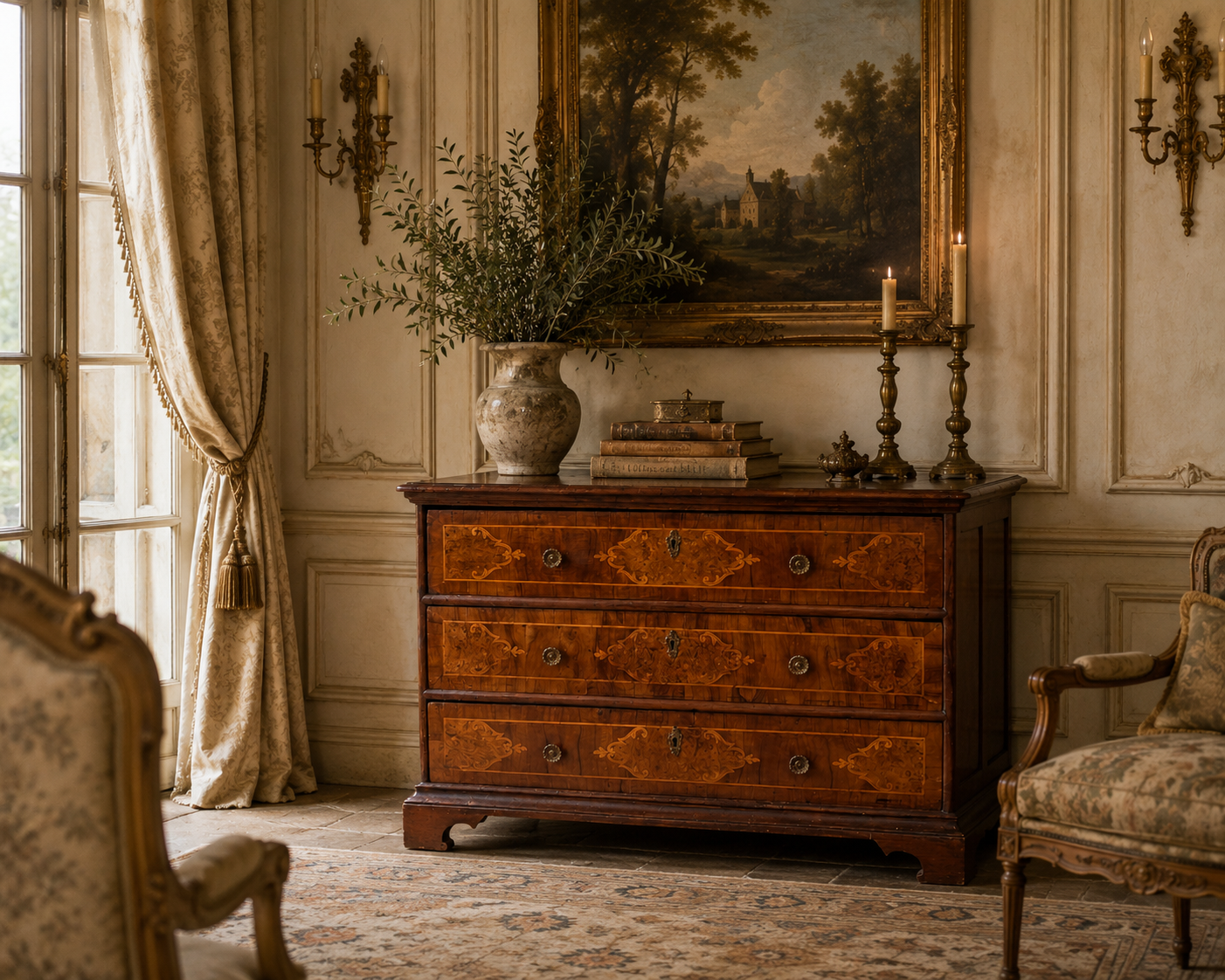
Antique 18th c. Italian Walnut Chest with Inlay
Antique 18th c. Italian Walnut Chest with Inlay
Low stock: 1 left
Couldn't load pickup availability
Important Shipping Information
Important Shipping Information
Please allow up to 5 business days (Monday–Friday, excluding holidays) for your order to be carefully processed, packed, and prepared for shipment.
Return Policy
Return Policy
We want you to love your purchase. If for any reason you are not completely satisfied with an eligible item, we are happy to accept returns in accordance with our Return & Refund policy. You can find the full policy here.
Final Sale Items:
- Antique and vintage items
- Furniture and oversized freight shipments
- Clearance and sale merchandise
- Special orders or custom orders
- Gift cards
Antique Italian Chest
- antique circa 1770
- found in the French countryside
- from Northern Italy
- Approximately: 33" high x 47.5" wide x 16.75" deep
A handsome large-scale Northern Italian cassettone crafted in walnut and decorated with finely figured burl walnut reserves framed by delicate fruitwood string inlay. The three long drawers retain their original architectural proportions and sit above shaped bracket feet. Rich patina, age-darkened surfaces, historic wear, and natural veneer movement throughout attest to more than two centuries of age. Elegant in its restraint, the piece relies on the beauty of its materials rather than excessive ornamentation, making it particularly versatile in both traditional and contemporary interiors.
Crafted in Northern Italy during the late 18th to early 19th century, this substantial walnut cassettone exemplifies the refined craftsmanship that characterized Italian cabinetmaking during the transition from the Baroque period into the Neoclassical era. Constructed with a solid wood carcass veneered in richly figured walnut, the chest is further embellished with burl walnut reserves framed by delicate fruitwood string inlay. Rather than relying on elaborate carving or gilding, the maker allowed the natural beauty of the wood itself to serve as the primary ornamentation—a hallmark of many fine Italian furnishings of the period.
Several construction details help distinguish this piece from later reproductions. The drawer fronts retain hand-applied veneer displaying natural shrinkage, age separation, and irregularities developed over more than two centuries. The substantial solid wood top exhibits deep oxidation, softened edges from generations of use, and historic surface wear that cannot be convincingly replicated. The old board back, hand-worked secondary woods, and early drawer construction further support an 18th-century origin. These signs of age are important because they provide tangible evidence of authenticity, documenting the natural movement and wear patterns expected from furniture that has survived for well over two hundred years.
The chest’s form and decoration strongly suggest Northern Italian origin. The warm walnut coloration, restrained geometric stringing, burl walnut cartouches, robust proportions, and shaped bracket feet are all features frequently encountered in Italian furniture of the period. Unlike many contemporary French commodes, which often emphasize more architectural forms, gilt bronze mounts, or refined tapered legs, this piece possesses the practical elegance and robust construction associated with Italian domestic furniture.
Originally, a cassettone of this scale would have served as an important storage piece within a well-appointed home, holding clothing, household linens, textiles, and family possessions. Its generous proportions suggest it was intended as a principal furnishing rather than a secondary bedroom chest, likely occupying a prominent position within a bedchamber, reception room, or family apartment.
Today, the chest remains remarkable not only for its decorative appeal but also for the honesty of its condition. The wear visible across the top, corners, drawer fronts, and feet tells a coherent story of centuries of use, while the rich patina and mellow coloration reflect the passage of time in a way that only genuine period furniture can achieve. Together, these characteristics make it an exceptional example of late 18th-century Italian craftsmanship and a highly desirable decorative statement for modern interiors.